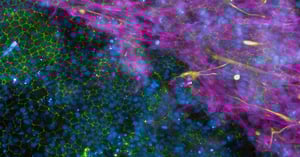
High-content imaging, or high-content screening, is a transformative approach to preclinical research, powering breakthroughs in drug discovery and translational science. It offers a number of unique advantages over traditional assays that make it especially powerful in scientific research.
Table of Contents
Cellular Analysis Through Multiplex Imaging
Enhancing Predictivity and Translational Relevance in Drug Discovery
Integrating Imaging with Multi-Omic Data for Deeper Insights
Cellular Analysis Through Multiplexed Imaging
High-content imaging (HCI) enables simultaneous quantification of multiple biological parameters within the same experimental well by leveraging advanced multiplexed staining and imaging strategies. This multiplexed approach allows researchers to analyze diverse cellular phenotypes, signaling pathways, and subcellular structures in parallel, drastically increasing experimental throughput while preserving biological context.
Unlike single-endpoint assays, HCI can measure dozens to thousands of features per cell simultaneously, enabling researchers to capture complex biological responses, rather than individual responses or oversimplified readouts. By extracting rich multiparametric data from a single assay, HCI provides comprehensive insights into cellular responses, cell-to-cell heterogeneity, and morphological changes. Capturing population heterogeneity can be critical in areas like cancer biology and immunology. HCI enhances the efficiency and depth of preclinical studies, facilitating more informed decision-making during drug screening and mechanistic investigations.
Additionally, an image-based approach preserves spatial relationships in a biological system. This allows researchers to study and characterize phenomena like protein translocation, cell-cell interactions, and subcellular compartmentalization - all of which are typically lost in most biochemical assays. Preserving the spatial and contextual information of a biological system can be critical in our understanding diseases or efficacies of therapeutic candidates.
HCI excels at phenotype-driven discovery, where compounds or genetic perturbations are assessed based on observable cellular changes rather than predefined targets. This supports capturing subtle and complex cellular changes that may be missed by conventional assays. Quantitative imaging and automated analysis tools facilitate rapid, unbiased profiling of cellular responses to perturbations, supporting the elucidation of mechanisms of action for investigational compounds.
Through single-cell resolution and robust statistical analysis, HCI enables the identification of rare cellular subpopulations, off-target effects, and pathway-specific responses, streamlining hit-to-lead prioritization and supporting the optimization of therapeutic candidates.
Enhancing Predictivity and Translational Relevance in Drug Discovery
The adoption of high-content imaging supports the development of more physiologically relevant in vitro models, including 3D organoids and iPSC-derived systems. The quality and translatability of HCI assays is directly related to that of the model itself, and this strategy easily encompasses the use of advanced cell-culture models, including primary cells, iPSC-derived systems, and co-cultures. By enabling high-resolution, single-cell analysis within complex models, HCI bridges the gap between traditional 2D assays and in vivo biology, thereby improving translational predictivity.
This approach allows researchers to assess compound efficacy, toxicity, and off-target effects in a human-relevant context. The use of in vitro systems affords the ability to scale up and automate experiments and data collection, which is a major financial hurdle faced when using in vivo models. HCI can ultimately reduce reliance on animal models and increase confidence in preclinical candidate selection through the use of human-relevant systems. Enhanced predictivity and context drive improved clinical outcomes and de-risk development pipelines for both small molecules and advanced therapeutics.
HCI is uniquely positioned to analyze complex cell-culture models, such as 3D organoids and co-cultures of multiple cell types, which better recapitulate the complexity of native tissues. Automated, confocal imaging platforms capture spatial and contextual information within dense 3D structures, enabling researchers to evaluate tissue architecture, cell-cell interactions, and microenvironmental effects. The details afforded by the use of these complex models is typically lost and inaccessible by other, non-imaging approaches.
By quantifying phenotypes and functional endpoints in these models, HCI empowers translational research with greater accuracy and relevance.
Integrating Imaging with Multi-omic Data for Deeper Insights
The integration of HCI data with multi-omic datasets—such as transcriptomics, proteomics, and metabolomics—provides a multidimensional view of cellular states and drug responses. This holistic approach enables the identification of novel biomarkers, mechanistic pathways, and predictive signatures that inform both target validation and therapeutic development.
HCI datasets are ideal for advanced analytics and integration with AI and machine learning due to their rich, complex nature. HCI datasets that capture unbiased, phenotype classifications, morphological profiling, and predictive modeling of drug effects/toxicity provide valuable insights complementary to other large-scale profiling techniques like proteomics, transcriptomics, and metabolomics. The use of AI can also uncover patterns invisible to the human eye.
Advanced analytical pipelines and data integration strategies facilitate the translation of high-content phenotypic data into actionable insights, supporting a systems biology approach to preclinical research. This integration ultimately drives more robust, data-rich discovery programs and strengthens the foundation for precision medicine initiatives.